-
dazemoonmarketing
- October 23, 2026
- No Comments
Author’s Note:
Italian marble has played an important role in architectural history, from classical monuments and Renaissance buildings to contemporary luxury residences and commercial spaces. Its distinctive veining, natural beauty, and ability to complement different architectural styles have made it a sought-after material for centuries. Understanding its history helps architects, designers, builders, and homeowners appreciate not only its appearance but also the craftsmanship and planning involved in using natural stone. This article explores the evolution of Italian marble, its architectural applications, and its continuing relevance in modern design.
Table of Contents
- The Origins of Italian Marble in Architecture
- Italian Marble Through Different Architectural Periods
- How Italian Marble Influences Modern Architecture
- Choosing Italian Marble for Contemporary Projects
- Conclusion
- FAQs
1. The Origins of Italian Marble in Architecture
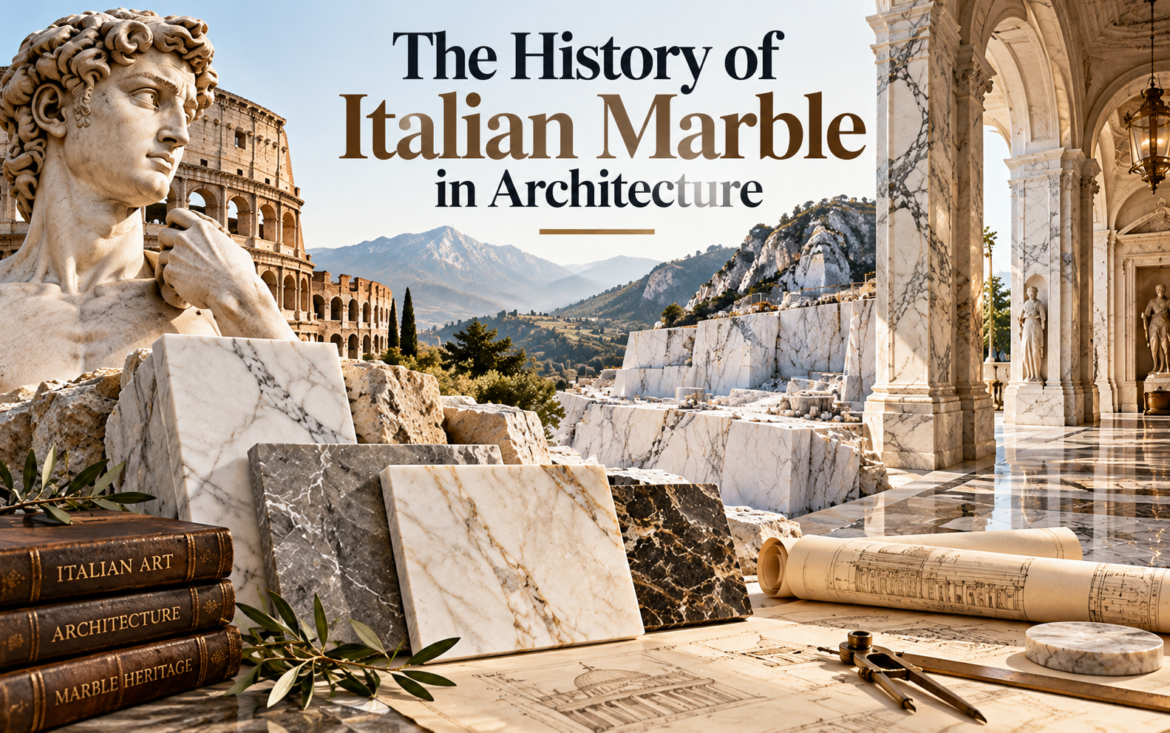
The history of Italian marble is closely connected with the geology of the Italian peninsula, particularly the marble-rich Apuan Alps in Tuscany. The Carrara region became renowned for its white and grey marble, which has been quarried for centuries and used in sculptures, monuments, and buildings.
Marble forms when limestone or related carbonate rocks undergo heat and pressure, causing changes in their mineral structure. The resulting stone can display different colors, textures, and patterns depending on its mineral composition and geological history.
Ancient builders valued marble because it could be cut, shaped, polished, and used for both structural and decorative purposes. Its relatively consistent appearance in selected varieties made it suitable for columns, architectural details, statues, and prestigious public buildings.
As quarrying techniques and transportation improved, marble became more accessible to architects and craftsmen. Its use gradually expanded across different building types, although cost, availability, and the labor required to work with stone influenced where and how it was used.
Today, a Best imported marble supplier in India can help modern buyers explore Italian varieties that continue this architectural tradition while meeting contemporary design requirements.
2. Italian Marble Through Different Architectural Periods
Ancient Roman architecture
The Romans used marble extensively in temples, public buildings, monuments, baths, and elite residences. Marble became associated with civic importance, wealth, and architectural grandeur. As the Roman Empire expanded, stone from different regions entered Roman construction and decoration, broadening the range of available materials.
Marble columns, wall coverings, decorative floors, and sculptural elements helped establish a visual language that influenced later European architecture. Roman builders also developed sophisticated approaches to transporting and processing stone on a large scale.
The Renaissance period
During the Renaissance, architects and sculptors renewed their interest in classical Greek and Roman principles. Italian marble became especially important for sculptures, palaces, churches, and architectural ornamentation.
Artists and craftsmen valued the stone for its ability to reveal fine details when carved. Its surface could also be polished to highlight the natural character of the material. Marble became a defining feature of many buildings that emphasized proportion, symmetry, craftsmanship, and artistic expression.
Neoclassical and modern movements
Later architectural movements continued to use marble in public institutions, memorials, luxury residences, and monumental interiors. Neoclassical architecture drew inspiration from ancient columns, pediments, and balanced compositions, often incorporating marble to reinforce the connection with classical design.
In modern architecture, marble is no longer limited to monumental buildings. Improved fabrication, international trade, and modern installation methods have made it possible to use the material in apartments, hotels, offices, retail spaces, and private homes.
3. How Italian Marble Influences Modern Architecture
Contemporary architecture uses marble in more varied ways than traditional monumental construction. Instead of covering every surface, designers may use it selectively to establish visual hierarchy, introduce texture, or create a focal point.
White marble with grey veining is often selected for minimalist interiors, while darker or more strongly patterned varieties can provide contrast in reception areas, feature walls, and hospitality spaces. Beige tones can complement wood, while grey marble can coordinate with glass, metal, and concrete.
Large slabs and carefully planned veining can create a continuous appearance across walls and floors. Book-matched marble, in which adjacent slabs are arranged to create mirrored patterns, is another technique used for reception desks, feature walls, and decorative panels.
However, marble selection must consider practical performance as well as aesthetics. Natural marble can be sensitive to acidic substances, and polished finishes may become slippery when wet. High-traffic areas require suitable finishes, careful installation, and appropriate maintenance.
For projects sourcing Italian marble in kishangarh, inspecting actual slabs is particularly useful because natural patterns and color variations can differ from photographs or small samples.
4. Choosing Italian Marble for Contemporary Projects
Selecting marble for a modern building begins with understanding the purpose of each space. Flooring, wall cladding, countertops, staircases, and decorative installations may require different thicknesses, finishes, fabrication methods, and maintenance routines.
Architects and interior designers should compare the stone’s color, veining, dimensions, and finish with the building’s lighting, furniture, and overall material palette. They should also consider expected foot traffic, moisture exposure, cleaning methods, and installation conditions.
Budget planning is equally important. When evaluating Italian marble flooring price India, buyers should account for more than the material’s quoted rate. Transportation, cutting, wastage, installation, polishing, finishing, and maintenance can influence the final project cost.
A professional Marble supplier in Kishangarh can help buyers compare available varieties and understand differences in slab dimensions, finish, and suitability. Visiting a Best marble shop in Kishangarh allows project teams to inspect actual stone and discuss the quantity needed for the design.
Before confirming a purchase, ask for clear product information, inspect the selected slabs, and coordinate the material specifications with the architect or installer. An experienced Marble dealer in Kishangarh should also clarify delivery arrangements, inspection procedures, and applicable commercial terms.
5. Conclusion
Italian marble has evolved from a material used in classical monuments and Renaissance masterpieces into a versatile option for modern architectural projects. Its history reflects the relationship between geology, craftsmanship, technology, and design.
Today, marble continues to offer architects and designers opportunities to create distinctive spaces, whether through subtle flooring, dramatic feature walls, sculptural details, or elegant public interiors. Its success in any project depends on choosing the appropriate variety, understanding its limitations, and ensuring professional installation and maintenance.
By combining historical appreciation with practical planning, buyers can select Italian marble that supports their architectural vision while respecting the natural characteristics of the stone.
FAQs
1. Why has Italian marble been used in architecture for centuries?
Italian marble has been valued for its natural patterns, ability to be carved and polished, and suitability for decorative and architectural applications. Its use in historic monuments also established strong cultural associations with craftsmanship and prestige.
2. Which Italian marble region is historically famous?
Carrara in Tuscany is one of Italy’s best-known marble-producing regions. Its white and grey marble has been used for centuries in sculpture, monuments, and architecture.
3. How was Italian marble used in ancient Roman buildings?
Romans used marble for columns, monuments, decorative flooring, wall coverings, temples, public buildings, and sculptures. Its use often communicated wealth, civic importance, and architectural grandeur.
4. Is Italian marble suitable for modern architecture?
Yes. It can be used in contemporary homes, hotels, offices, and commercial buildings for flooring, feature walls, reception counters, and decorative details. Selection should account for the intended application and maintenance requirements.
5. What should buyers consider before purchasing Italian marble?
Buyers should consider the stone’s variety, origin, color, veining, thickness, finish, quantity, installation method, maintenance needs, and complete project cost. Inspecting actual slabs helps ensure that the selected material matches the intended design.